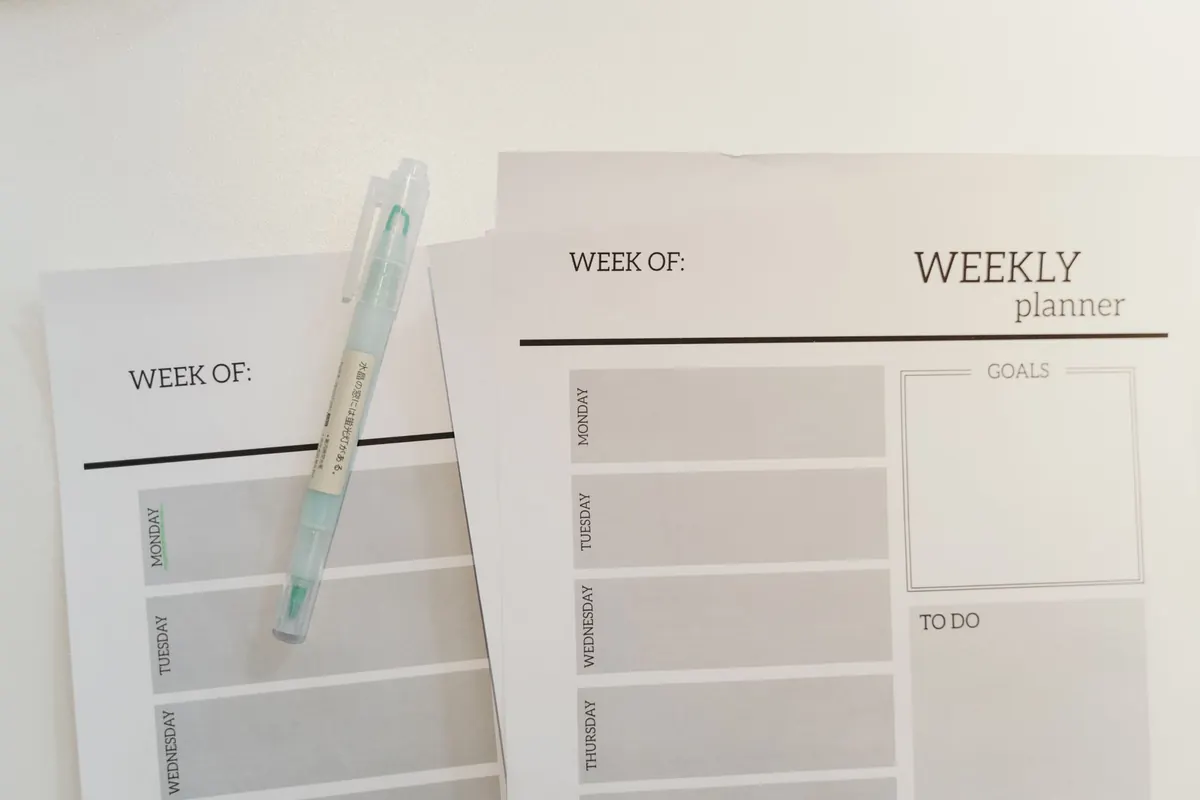
Most weekly planning advice assumes you want to fit more into seven days. It starts with a crowded calendar and asks how to squeeze. Planning a slow living week works the other way around: you begin with empty space and then decide, on purpose, what deserves to fill it. The goal isn't a perfect schedule. It's a week you can get through without running on empty, with room for rest, margin, and fewer obligations than you'd normally accept.
The whole method takes about twenty minutes, once a week, usually on a Sunday evening or a Friday afternoon. You don't need an app or a special notebook. A sheet of paper and a pencil will do nicely.
Open a fresh page and draw seven boxes, one for each day. Now write in only what is genuinely fixed: your working hours, the school run, a dental appointment, the evening your partner is out, the day the recycling is collected. Nothing else goes in yet.
Most people are surprised by how little space those fixed commitments actually take. What fills a calendar is rarely the unavoidable. It's the accumulated yeses, the "while I'm at it" errands, and the tasks carried over from last week out of guilt rather than necessity.
Leave the rest of the page blank for now. That white space is your raw material, and protecting it is the whole exercise. If you feel a small pang of anxiety looking at an underfilled week, notice it. That pang is usually habit, not a real problem.
An anchor is something that makes the week feel like yours, not something that merely needs doing. Three is enough. Choose more and you'll start treating them as a checklist, which defeats the purpose.
Write those three at the top of your page, above the chores, and give them real slots before anything else claims the space. If Friday arrives and only the anchors happened, the week counted. That's a different measure of success from the one most planners use, and it takes some getting used to.
Margin is the space between commitments, and it's the first thing to disappear when a week gets busy. A day with four appointments can be heavier than one with six if the four are back-to-back and involve crossing town.
A simple guide: fill no more than about two-thirds of your waking hours on any given day. If a meeting ends at four, don't book something at ten past. Leave twenty minutes for the walk to the car, the queue at the pharmacy, the phone call you didn't expect. None of that is wasted time. It's the cushion that keeps a day from tipping over.
Rest that isn't planned tends to be the first thing traded away. But planning it too tightly ruins it, so keep this loose. Write a block called "nothing" and give it no objective. Sit in the garden. Lie on the floor for ten minutes. Walk to the shop the long way without headphones.
Be honest about what actually rests you. An hour of scrolling rarely leaves anyone feeling better, while a nap, a bath, or a slow conversation usually does. Match the rest to your energy: if you're worn out, lie down; if you're restless, move. Small amounts count. Twenty quiet minutes on a Tuesday can change the shape of an entire week, and nobody needs to know you scheduled them.
Before the week starts, read your plan and take things out. This is the step people skip, and it's the one that makes the difference. Go through the list with a pencil:
You won't get the balance right the first time. Aim for a week that looks slightly under-filled on paper. In practice it will fill itself.
At the end of the week, spend five minutes with the same page. Which anchor actually happened? Where did the week get crowded, and what crowded it? What would you move if you could do it again?
Don't grade yourself. Adjust one thing for the next week — a gap moved, an appointment declined, an anchor swapped for one you'd enjoy more. After a month or so a pattern appears. The same commitment keeps swallowing the rest, or the same evening keeps going missing. That's useful information, and it's much easier to see when you've been looking at your weeks on paper.
Pick a day, set aside twenty minutes, and plan the next seven days on a blank page. Three anchors. Room between commitments. One stretch of genuine rest. A couple of things removed before they ever reach the calendar.
It will feel odd the first time, and the page will look emptier than you're used to. Let it. A slow living week isn't about doing less for its own sake. It's about making sure the things you do have room to be done properly, and that you have enough left over on Friday evening to enjoy your own life.
If your week is tightly constrained by shift work, caregiving, or health, scale this down rather than abandon it: one anchor and one gap is a reasonable start. Then try again the following week.
Photo: cottonbro studio / Pexels